



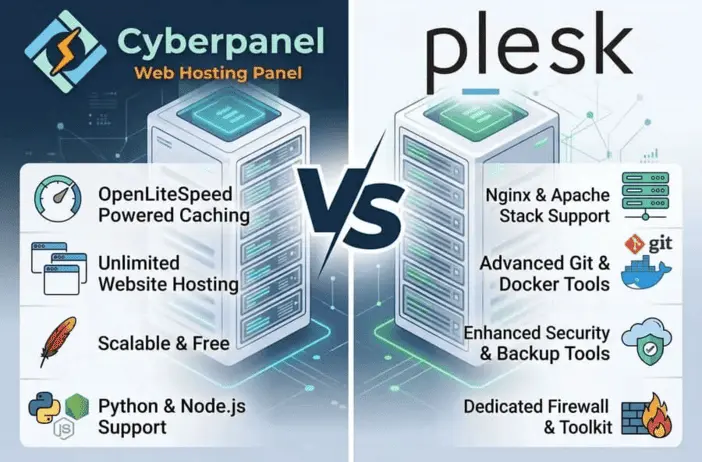
CyberPanel vs Plesk: Which is Better for Laravel Projects?
When deploying a modern Laravel application to production, your choice of server infrastructure and control panel dictates the fate of your project. In the web hosting industry, two giants frequently clash: the open-source CyberPanel and the enterprise-grade Plesk. But when it comes to hosting a mission-critical Laravel app, which one truly delivers?
In this guide, we dive deep into the technical details, exposing the chronic issues hidden behind CyberPanel's "free" price tag and explaining why Plesk has remained the rock-solid industry standard for years.
The Dark Side of CyberPanel: Update Nightmares and Instability
While CyberPanel promises blazing speeds powered by OpenLiteSpeed (OLS), it completely fails when it comes to stability. Using CyberPanel for complex frameworks with deep dependencies like Laravel is akin to sitting on a ticking time bomb.
- Update Breakages: The biggest nightmare for CyberPanel users is version updates. Having the Python core crash, the MariaDB service halt, or facing a "503 Service Unavailable" error on the panel interface after a simple update is just a regular Tuesday in the CyberPanel ecosystem.
- .htaccess and Routing Issues: Laravel's routing requires flawless URL rewriting. OpenLiteSpeed, which CyberPanel uses, does not read Apache `.htaccess` rules in real-time. You are forced to restart the LiteSpeed service manually after every single route or rewrite rule change.
- Fragile Ecosystem: The integration between plugins and background services is extremely weak. An SSL certificate that works perfectly today might fail to renew tomorrow due to a random bug in their Let's Encrypt module.
Plesk: Enterprise-Grade, Rock-Solid Stability
In stark contrast, Plesk is an enterprise engineering marvel that allows you to sit back and focus solely on writing code. With Plesk, you never wake up worrying, "What is going to crash on the server today?"
Plesk is powered by the battle-tested architecture of Nginx and Apache (Reverse Proxy) or pure Nginx processing. It perfectly optimizes PHP-FPM execution for Laravel projects. Pair it with Redis Object Caching and the OPcache JIT (Just-In-Time) compiler, and your database queries will fly, ensuring your app responds in milliseconds even under high traffic.
Continuous Integration (CI/CD): Git and Composer Workflow
If you are still deploying a Laravel project via FTP, you are losing valuable time. Modern web development is built around version control systems.
Plesk Git Extension
You can connect your GitHub, GitLab, or Bitbucket repositories directly to Plesk. Thanks to webhooks, the moment you run `git push`, Plesk pulls the code to the server, runs `composer install` automatically, and deploys your project with zero downtime. It is a flawless Continuous Deployment (CD) pipeline.
CyberPanel Git
CyberPanel's Git manager is clunky and rudimentary. Connecting a repo and setting up auto-deployment via the GUI frequently throws errors. Most of the time, you are forced to log in via SSH and run manual commands in the terminal, completely defeating the purpose of using a control panel.
Developer's Comparison Summary
| Criteria | CyberPanel | Plesk Obsidian |
|---|---|---|
| System Stability | Fragile (High risk of update crashes) | Rock-Solid (Enterprise architecture) |
| Web Server | OpenLiteSpeed | Nginx / Apache / PHP-FPM |
| URL Routing & Rewrites | Requires service restart for rules | Nginx/Apache rules processed instantly |
| Database Management | Limited optimization | Advanced MariaDB & Redis management |
| Cost | Free | Paid |
Conclusion: Which One for Laravel?
If you are a student, working on a personal hobby project, and unexpected server downtime won't cause a crisis, you can take advantage of CyberPanel's free tier.
However, if you are serving clients, hosting e-commerce sites, or simply have zero tolerance for downtime, Plesk is your only option. Plesk is not an expense; it is an insurance policy that keeps your websites online and your business running smoothly.
Looking for a Stable Home for Your Application?
At GreenLeafWeb, we offer high-performance Plesk Shared Hosting featuring pure NVMe SSDs and robust Nginx infrastructure. Experience the ultimate environment to host your Laravel projects without interruptions.